

Water Contact Report



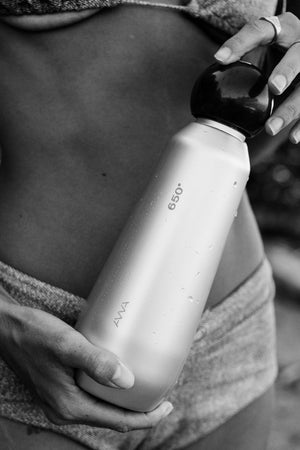

Here's Your
Water Report
Your current water bottle may contain plastic, heavy metals, or other materials that can affect the wellness and pleasure of drinking water. Since you can't see inside your bottle, let's take a look together.

PureGrade™
Not All Steel
Is Equal
This is where AWA starts: premium, food-grade 316L stainless steel, inside and out.
Most mainstream bottles use 304 stainless steel (also labeled 18/8) on the inside, a lower, inferior grade with less resistance to corrosion. Some brands use an even lower grade and simply don't disclose it at all.
This matters more than it sounds like it should. In almost every bottle on the market, your water sits directly against raw, uncoated steel, there's no liner or coating standing between the two. So the grade of that steel is the single biggest factor in what, if anything, ends up in your water. 316L resists acidity, salts, chlorine, and heat far better than 304, which means less opportunity for trace metal to migrate into your drink over time, especially with hot liquids or anything acidic like lemon water or electrolytes.
When a brand won't say what grade of steel it uses, treat that the same way you'd treat a lower grade: a reason for caution, not confidence.

True Stainless Steel™
A Material
Difference
Not all metals are created equal.
Acidity, salts, carbonation and heat can all be more demanding on the surface inside your bottle, from lemon water and electrolytes to sparkling water, coffee and tea. Lower-grade stainless steel and aluminum offer less resistance to corrosion, which can allow trace amounts of metal to migrate into what you drink.
AWA is made from corrosion-resistant 316L stainless steel, inside and out, creating a more stable, resilient surface for everything you drink.

AWA Steel

What's Inside The Seal
The Lead
Seal Pellet
Most double-wall insulated bottles close their vacuum cavity with a small lead solder pellet, fully encased in steel. It's not meant to touch your drink, but it's still there, and not every brand tells you.
Stanley has confirmed this in its own published FAQ, and independent XRF testing, including by Lead Safe Mama, a consumer-safety researcher who publishes lead-testing results on video, has found lead in Stanley and Yeti tumblers at the base, encased under the steel cap and generally sealed away from the drink under normal use. ThermoFlask bottles have also tested positive for lead in independent testing, with the contaminated spot covered only by exterior paint rather than steel. Hydro Flask, Owala, and Klean Kanteen have each confirmed lead-free sealing methods instead.
AWA's interior is lead-free: nothing your water touches contains lead.

Interior Finish
Polished
Or Not
A rough, unpolished interior is the perfect bed for bacteria and odor to grow.
AWA is micropolished at the microscopic level to ensure the smoothest possible surface, avoiding odor buildup and keeping every sip tasting clean and fresh.
Electropolishing is the same process used on surgical and medical-grade instruments, chosen there for the same reasons: a smoother, more hygienic surface with nowhere for residue to hide.
The approach borrows from nature: the way a duck's feathers or a lotus leaf shed water and contaminants rather than holding onto them. We apply that same principle to steel, transforming the surface into a smoother, glass-like finish.

The Hidden Layer
Steel With a
Plastic Lining
Yes, even bottles marked "steel" or "stainless steel" sometimes have a plastic lining or spray coating on the inside. That means your water is touching that lining, not steel.
AWA is just high-grade 316L stainless steel, with no plastic or spray coating inside, ever.
- No plastic liner
- No interior spray coating
- A smooth, consistent interior finish
Context matters here: water briefly flowing past a plastic surface, or sealed for a moment by a gasket, is a different exposure than water sitting still against a plastic lining for hours. Contact time is what the research is actually about. Coatings also vary by model within a brand's own lineup, not just between brands, so we note it below when that's the case.

In The Interest Of Full Disclosure
About
The Lid
The lid on AWA Steel is BPA-free plastic, sealed with a food-grade silicone gasket that locks in carbonation and keeps leaks out of your bag.
Our double seal is built to avoid leaks and to hold carbonation better than a single-gasket lid, a result that's only possible with food-grade silicone sealing rings.
When the bottle is filled correctly and kept upright, the lid doesn't make contact with the water inside. Your drink only ever touches the 316L steel body. Very few bottles on the market use an all-metal lid, and even the ones that do almost always rely on a rubber or silicone O-ring to seal. Some plastic or silicone contact at the lid is close to universal in this category, ours included. We'd rather tell you than have you assume otherwise.
The same contact-time principle applies here: a gasket briefly sealing an opening, or water flowing past it for a moment, isn't the same exposure as water sitting against plastic for hours.
Your Report
You Searched For
This Bottle
Most double-wall insulated bottles seal the vacuum cavity with a small lead solder pellet, fully encased in steel. AWA's interior, everything your water touches, is lead-free.
Water Contact Score™
Your Bottle
· / 100
AWA
100 / 100
A simple, disclosed rubric: steel grade, interior finish, and transparency each carry weight, with a flat baseline for long-term care. A brand that won't publish its grade, finish, or seal material scores lower than one that discloses a solid tier, but not as low as a brand with a confirmed lower-grade spec, undisclosed isn't treated the same as bad. Not a safety rating.
Material Care
Treat It
Like Steel
The inside matters just as much as the outside. Mineral deposits and residue can build up in any reusable bottle over time, even one that looks clean.
You can actually damage the inside of your bottle by scrubbing it with abrasive brushes, which can create tiny scratches and crevices where odor and bacteria like to build up.
Give yours a real clean regularly, skip anything abrasive on a polished surface, and if the inside is already scratched up, it might be time for an upgrade.
Better Materials
Built To Last
This is the AWA philosophy.

Ready For An Upgrade.
AWA Steel
316L stainless steel. Electropolished. Lead-free interior.
No plastic. No coating. Nothing to hide.
Where This Comes From
Sources &
Research
We cite sources by name rather than linking out, so you can verify independently without leaving your report.
Common Questions
What People
Ask Us
Does AWA's stainless steel bottle have a plastic liner or coating inside?
No. AWA Steel is 316L stainless steel inside and out, electropolished at a microscopic level. There's no plastic liner and no interior spray coating anywhere your water touches, just steel.
What is AWA's lid made of?
The lid is BPA-free plastic with a food-grade silicone gasket for the seal. When the bottle is filled correctly and kept upright, the lid doesn't contact the water inside. All-metal lids are rare in this category, and even those typically still seal with a rubber or silicone O-ring. Some plastic or silicone contact at the lid is close to standard across the industry, AWA included.
Is the inside of an AWA bottle lead-free?
Yes. Everything your water touches in AWA Steel is lead-free: 316L stainless steel, with no liner or coating. For context, many double-wall insulated bottles close the vacuum cavity with a small lead solder pellet, fully encased in steel. Stanley has confirmed this in its own FAQ, and independent testing, including by Lead Safe Mama, has found lead in Stanley, Yeti, and ThermoFlask products. We only make the claim about the interior, the part that touches your drink.
What grade of stainless steel does AWA use, and why does it matter?
AWA uses 316L, the top standard for food-contact steel. Most competitor bottles use 304 (18/8), a lower grade with less corrosion resistance. 316L holds up better against acidity, salts, carbonation, and heat, which lowers the chance of trace metal migrating into your drink over time.
Is the inside of an AWA bottle polished or coated?
Polished, not coated. AWA's interior is electropolished using an electrical current, which smooths the surface at a microscopic level. That reduces the odor and bacteria buildup that comes with a rough, unpolished, or mechanically finished interior, with no spray coating involved.
How is AWA different from bottles like Hydro Flask, Yeti, or Stanley?
Most mainstream steel bottles use 304-grade steel and a mechanically finished (not electropolished) interior. Stanley and Yeti also use a lead solder pellet in the vacuum seal, confirmed in their own FAQs. AWA uses 316L steel, an electropolished interior, and a lead-free interior. See the full side-by-side comparison above for your specific bottle.
Curious About Another Bottle?
Look Inside
Another Bottle
First time? We'll just need your email and name once.
Sources: specs for each bottle are drawn from the manufacturer's own published materials pages. Where a brand doesn't publicly disclose a spec, we mark it "Not Reported" rather than guess. This report is educational and does not claim any bottle is unsafe.
Disclaimer
This report is provided for general informational and educational purposes only and does not constitute medical, health, safety, or legal advice. Brand names, trademarks, and product names referenced (including but not limited to Hydro Flask, Stanley, YETI, Owala, CamelBak, Klean Kanteen, Contigo, Takeya, ThermoFlask, Thermos, S'well, Corkcicle, Simple Modern, LARQ, Zojirushi, Amazon Basics, Ozark Trail, Mainstays, RTIC, and Frank Green) are the property of their respective owners. AWA is not affiliated with, endorsed by, or sponsored by any of these brands, and no such affiliation or endorsement should be inferred.
Specifications, materials, and claims about third-party products are compiled in good faith from publicly available manufacturer disclosures, published FAQs, retailer listings, and independent third-party testing as cited above, and reflect our understanding as of the date this page was last updated. Manufacturers may change materials, specifications, or sourcing at any time without notice, and we do not independently verify every manufacturer's claims. The "Water Contact Score," and the "Best," "Basic," "Undisclosed," and "Bad" ratings shown are AWA's own opinion-based methodology, not an independent certification, laboratory result, or regulatory finding, and should not be relied upon as a safety determination for any product.
To the fullest extent permitted by law, AWA makes no warranty, express or implied, as to the accuracy or completeness of the information on this page, and disclaims liability for any errors, omissions, or outcomes arising from reliance on it. If you believe any information here about your product is inaccurate or outdated, please contact us so we can review and correct it.